
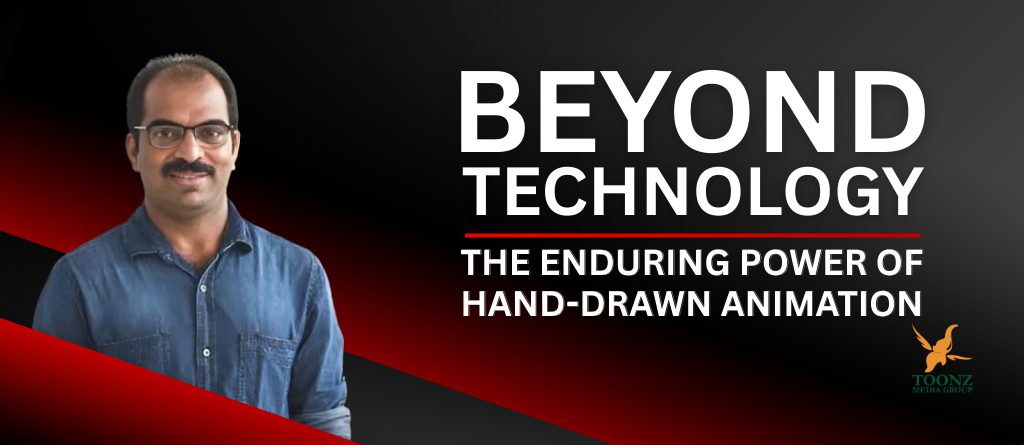
Beyond Technology: The Enduring Power of Hand-Drawn Animation
admin2026-02-23T04:38:40+00:00In an era where AI can generate animation in seconds and software can replicate almost any visual style, many young artists are asking a serious question: is traditional animation still relevant?
For UK Prakashan, the answer is clear. Traditional animation is not just relevant. It is foundational.
With 26 years of experience at Toonz Media Group, Prakashan has grown alongside the transformation of the animation industry. He began his journey in 1999 as an in-between artist, working entirely with pencil and paper. Every frame was drawn by hand. Every movement demanded observation, patience, and practice.
In those early years, growth followed a disciplined path. Artists started with in- betweens, moved to clean-up, sketched constantly, and gradually earned the opportunity to animate key scenes. The process was slow, but it built strong fundamentals. It shaped artists who understood weight, rhythm, and emotion before touching advanced tools.
Today, production floors look very different. Digital workflows dominate. Software accelerates pipelines. AI is beginning to influence creative processes. Yet, despite adapting to every technological shift, Prakashan remains deeply rooted in the belief that animation begins with drawing.
He explains his perspective in his own words:
“When we do traditional animation, the imagination travels from the mind to the fingers. The line itself carries feeling. It is not just a drawing. It is emotion, observation, rhythm. When I draw by hand, I feel more connected to the character. The movement becomes natural because it comes directly from inside. Digital tools are powerful and necessary. I use them. But sometimes the process becomes mechanical if we are not careful. Traditional animation gives flexibility. It allows you to breathe. It is like going to a forest after living in a city for a long time. In the city everything is fast, structured, concrete. In the forest you feel fresh air, you see the trees, you hear the water. That is how I feel when I return to traditional drawing. It refreshes me as an artist. Even if technology changes, this connection should not disappear. For the survival of the artist and the art itself, traditional animation must continue.”
Contrary to the belief that hand drawn animation is fading, there is still strong demand internationally. Countries like Japan continue to rely heavily on traditional workflows influenced by manga traditions. Studios receive inquiries for projects that require authentic hand drawn aesthetics. The challenge, however, is not demand. It is the shortage of trained artists who are willing to invest years in mastering the craft.
Prakashan believes that many students today are drawn toward fast results. Technology offers shortcuts, but fundamentals cannot be skipped. An animator must first be an artist. Observation of nature, daily sketching, understanding timing and expression are skills that no software can replace.
At the same time, he acknowledges that modern tools such as Toon Boom and Adobe software allow traditional workflows to exist within digital environments. Rough passes, clean-up, coloring and compositing can all be done efficiently while preserving the emotional integrity of hand drawn animation. Technology, in his view, should support creativity, not dominate it.
Reflecting on the Indian animation landscape, he feels there is still room to grow. Much of the industry remains focused on children’s content, while global markets have expanded animation into theatrical and adult storytelling spaces. To evolve further, India must invest in artist development and cultivate patience and discipline in training.
AI will continue to advance. Pipelines will become faster. Production demands will increase. But the core of animation remains human. It lives in observation, empathy, and the ability to translate feeling into motion.
For Prakashan, traditional animation is not nostalgia. It is a living discipline. And in a world racing toward automation, it remains a reminder that great animation still begins with a simple line drawn by hand.
For more such information check out: https://toonz.co