
Managing the Business of Creativity: Financial Lessons from Animation Production and Distribution
admin2026-02-12T04:31:33+00:00In conversations around successful animation IPs, the spotlight often falls on storytelling, characters, and creative vision. Yet behind every enduring franchise lies a quieter, equally decisive force: financial discipline. In animation, where timelines are long, costs are layered, and outcomes uncertain, financial strategy is not a back-office function. It is a creative enabler.
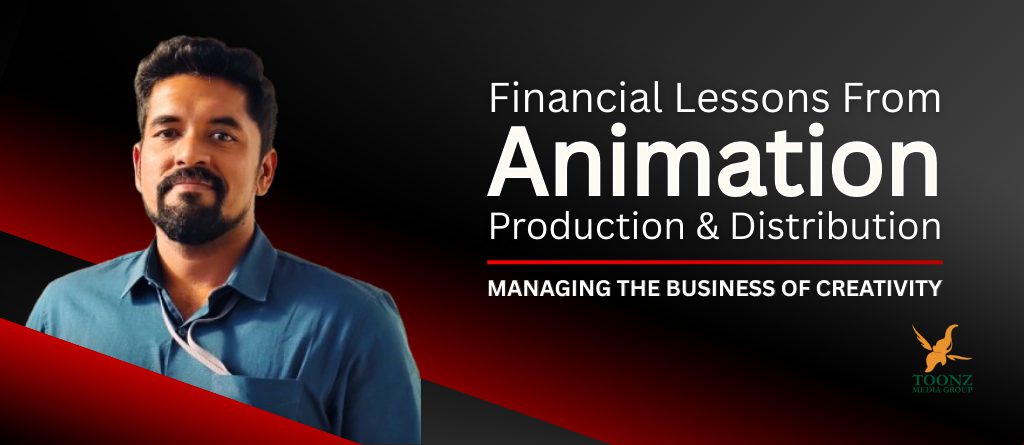
In a recent episode of Toonz Talks, Karthik V Kumar, Director – Finance at Toonz Media Group, offered a rare look into how finance shapes sustainable creativity in animation production and distribution. His insights reflect a truth many studios learn the hard way: great ideas thrive only when supported by sound economics.
Same Math, Different Magic
Having worked across consulting, energy, and manufacturing before entering the media and entertainment industry, Karthik brings an industry-agnostic lens to animation finance. While the creative environment may feel unpredictable, the fundamentals remain unchanged.
“It’s the same math, just different magic.”
At the heart of every animation project, whether a service deal, co- production, or original IP, are three foundational questions: What drives value? What drives cost? And where do the risks lie?
Understanding this triangle early determines whether a project remains viable across its lifecycle. In animation, where production cycles are long and assumptions can age quickly, financial models must be living systems, reviewed, tested, and adjusted continuously.
Cash Flow Is Oxygen
One principle Karthik emphasizes repeatedly is the role of cash flow. In creative businesses, profitability often receives attention only at the end of the process. But survival depends on liquidity throughout the journey.
Cash, as he puts it, is oxygen. Without disciplined cash management, even promising projects can stall before reaching the audience. This becomes especially critical in an era where content pipelines are crowded and monetization timelines are uncertain.
Navigating an Industry in Transition
The animation industry is currently navigating a complex phase, one marked by abundant distribution platforms but intense competition for attention. The challenge is no longer access to screens; it is earning and holding audience engagement.
At the same time, emerging technologies like AI are reshaping production economics, creating both opportunity and hesitation. Lower production costs promise efficiency, but they also introduce uncertainty, causing investors and broadcasters to reassess risk.
The solution, Karthik believes, lies not in resisting change but in embracing it thoughtfully by adapting business models, rethinking go-to- market strategies, and grounding creative ambition in financial realism.
Digital-First Thinking and Franchise Economics
A key shift in modern animation financing is the move toward digital-first IP development. Rather than pitching isolated shows, studios are increasingly expected to demonstrate scalable, monetizable ecosystems.
This is where data becomes indispensable. Digital platforms offer early signals, audience behavior, engagement patterns, and traction, that reduce uncertainty and build investor confidence. The goal is to build, prove, and then scale.
Crucially, the real value of successful IPs often lies beyond screen content. Licensing and merchandising continue to account for a significant share of long-term revenue, reinforcing the need to think in terms of franchises rather than formats.
Pre-Production: The Real Superpower
One of the most actionable insights from the conversation is the importance of pre-production. Cost overruns in animation rarely originate on the production floor; they are the result of decisions made much earlier.
“Pre-production is your superpower.”
From character design to format choices, early decisions shape downstream costs across the pipeline. Investing the right talent, time, and planning at this stage can prevent expensive corrections later—and protect both budgets and schedules.
Time, People, and Profitability
Animation is ultimately a people-driven business, and time is its most unforgiving variable. Every schedule slip directly erodes margins. Even small delays can disrupt billing cycles, strain cash flow, and undermine profitability.
This makes financial discipline inseparable from operational efficiency. Creativity flourishes best within clear guardrails, where expectations, timelines, and resources are aligned from the outset.
Finance as a Creative Partner
Rather than acting as a constraint, finance should function as a guide, providing direction without stifling imagination.
“Creative freedom is the goal. Financial discipline is the pathway.”
When finance and creativity work in tandem, studios are better equipped to build sustainable IPs, adapt to industry shifts, and deliver value to audiences and stakeholders alike.
In an industry defined by imagination, the most successful stories are often those backed by clarity, structure, and foresight.