
The Future of Animation Is Human-Led, AI-Powered
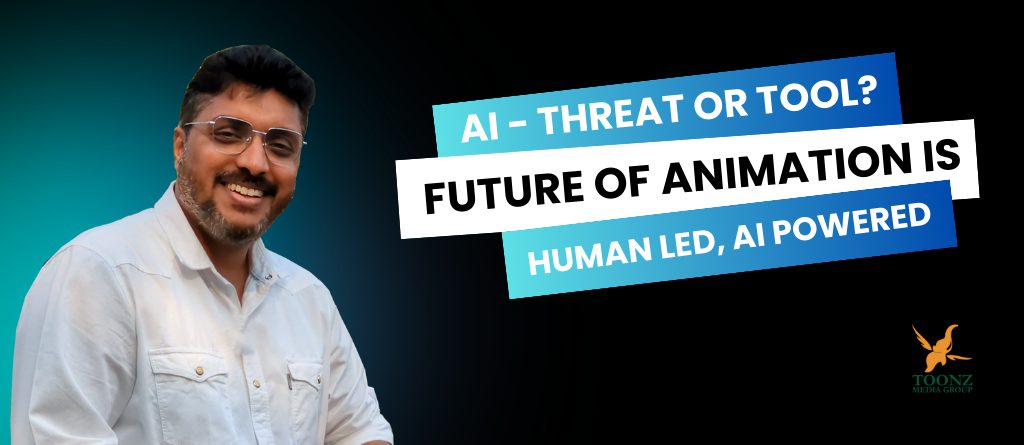
admin2026-01-29T09:24:19+00:00Artificial Intelligence has rapidly moved from the fringes of experimentation to the center of conversations in the animation and creative industries. What once felt like a futuristic add-on is now actively influencing how studios think about speed, scale, and sustainability. In a candid conversation on Toonz Talks, Babulu P George, Global Head – CG and Pipeline at Toonz Media Group, shared grounded, experience-driven insights on AI in animation, and AI is shaping animation not as a disruptor of creativity, but as an accelerator of process.
For Babulu, the connection between animation and technology began early, rooted in a fascination with moving images and visual storytelling. As tools evolved from traditional hand-drawn methods to computers and now to AI-assisted workflows, the driving force remained the same: curiosity. That curiosity pushed him to self-learn, experiment, and understand how emerging technologies could reduce production timelines that once stretched across months. AI, he notes, has fundamentally changed mindsets by demonstrating how certain tasks can be completed in minutes, allowing teams to rethink how time and effort are distributed across a project.
“AI is not here to replace artists. It helps us fast-track the process, but the final enhancement, emotion, and creative decisions will always come from humans. AI can support basic motion, texturing, and even expressions to a certain level, but exaggerated actions, performance, and storytelling are still completely human- driven. That balance is what will define how the industry moves forward.”
A recurring concern in the industry today is the changing viewing pattern of audiences. Strategies that worked a decade ago are often irrelevant now, and animation, being time-intensive, carries the risk of becoming outdated even before release. AI helps mitigate this by speeding up key stages such as pre-production, allowing studios to test ideas earlier, explore multiple creative options, and respond faster to shifting trends. However, Babulu is clear that AI outputs are not yet production-ready on their own. Consistency, especially in video generation, still falls short of the 100% precision required for professional pipelines, making human intervention essential.
The conversation also explored where AI is most effective today. Pre-production stands out as a major beneficiary, concept art, layout exploration, color studies, background matte paintings, and initial motion references are areas where AI can provide strong starting points. These outputs act as inspiration rather than final deliverables, giving artists more creative options instead of locking them into a single approach. In animation, AI-assisted motion can support normal human or animal movement, but complex action and stylized performances continue to rely heavily on artistic intuition and experience.
Beyond tools and workflows, the discussion touched on ethics, misuse, and regulation. As AI becomes more accessible, issues around copyright, content ownership, and data training are becoming unavoidable. Babulu expects clearer guidelines and laws to emerge globally, especially around training models on copyrighted material. Despite these challenges, he believes AI will not fade away, it will stabilize, mature, and integrate into everyday production life, much like
computers and the internet once did.
Another key theme was learning and accessibility. While many feel intimidated by AI, Babulu emphasizes that passion and basic understanding matter more than formal instruction. With tutorials, online resources, and community-driven knowledge sharing, learning AI today is easier than ever. What truly differentiates effective use is knowing how to apply it, writing the right prompts, understanding visual language, and aligning outputs with creative intent.
“We started with paper, moved to computers, and now we are embracing AI. This transformation is natural. At Toonz, we guide and motivate our teams rather than impose change. AI is a tool to support artists, speed up production, and meet growing demand. If you have curiosity and passion, AI becomes an assistant that helps you reach where you want to go.”
At Toonz Media Group, AI adoption is already underway carefully integrated into existing pipelines. The focus remains on empowering artists, not replacing them, and ensuring that technology serves creativity rather than overshadowing it. As the industry continues to evolve, one message stands clear from the conversation: AI is not the end of artistry, it is a new chapter, shaped by how thoughtfully it is used.