

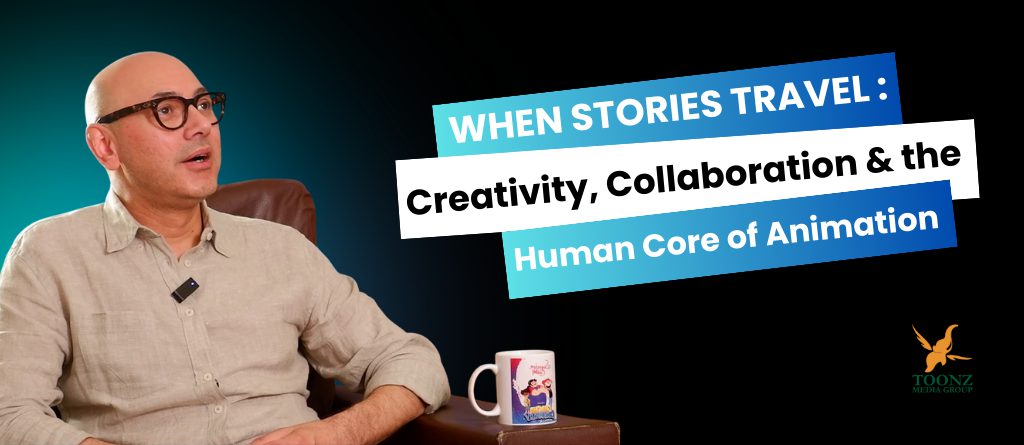
When Stories Travel: Creativity, Collaboration, and the Human Core of Animation
admin2026-01-27T04:54:35+00:00
Animation is often discussed in terms of technology, pipelines, and platforms, but at its heart, it remains a deeply human craft. That idea came into sharp focus during Robert Vargas’ recent visit to the Toonz studio in Kerala, India, where global collaboration met cultural exchange and creative alignment.
A Director of Development at Gaumont Animation, France, Robert has spent decades moving across roles, writer, storyboard artist, showrunner, executive producer, guided by one constant, storytelling. His journey reflects what animation truly demands today, versatility, collaboration, and the courage to choose creativity even when the path is uncertain.
What stood out most during his time in Kerala wasn’t just the cuisine or the exquisite coastline, it was the people. Collaboration, Robert believes, begins with human connection. Face-to-face conversations, shared meals, cultural exchanges, and trust built over time are what turn international co-productions into genuine creative partnerships. Technology may enable global workflows, but it’s relationships that create momentum, and magic.
This belief also shapes how he views long-distance co-production in the global animation industry. While digital tools make collaboration easier across borders, Robert stresses the importance of physical presence. As he puts it, “Nothing beats face-to-face human connection… that’s what elevates communication to the level where you’re trying to make something sublime.” For him, animation is both meticulously planned and emotionally intuitive, requiring what he describes as “lightning in a bottle.”
That same philosophy extends to how Robert views the future of animation. As platforms evolve, linear television declines, and short-form storytelling rises across digital spaces like YouTube and social media, the industry is in constant motion. Adaptability is no longer optional. Yet, amid all this change, one thing remains irreplaceable, human creativity. On the subject of artificial intelligence, he notes, “AI can never take the place of a human being… without that, it will feel hollow.” Used responsibly, technology should support artists, not replace them.
Robert also reflected on why French animation continues to attract global audiences. France’s deep-rooted graphic novel culture and strong animation schools have created an ecosystem where animation is seen as an art form for all ages. That cultural openness has helped fuel some of the world’s most compelling animated storytelling. In India too, perceptions are shifting, with animation increasingly being recognised as a powerful medium beyond children’s content, opening new
opportunities for studios and creators alike.
Ultimately, the future of animation doesn’t belong to systems or formats, it belongs to people. To the next generation of creators experimenting in garages, classrooms, and small studios. To voices telling stories in new ways, on new platforms. And to collaborators across borders who share a vision and build something together.
Animation evolves. Technology changes. Markets fluctuate.
But storytelling, driven by people, remains timeless.